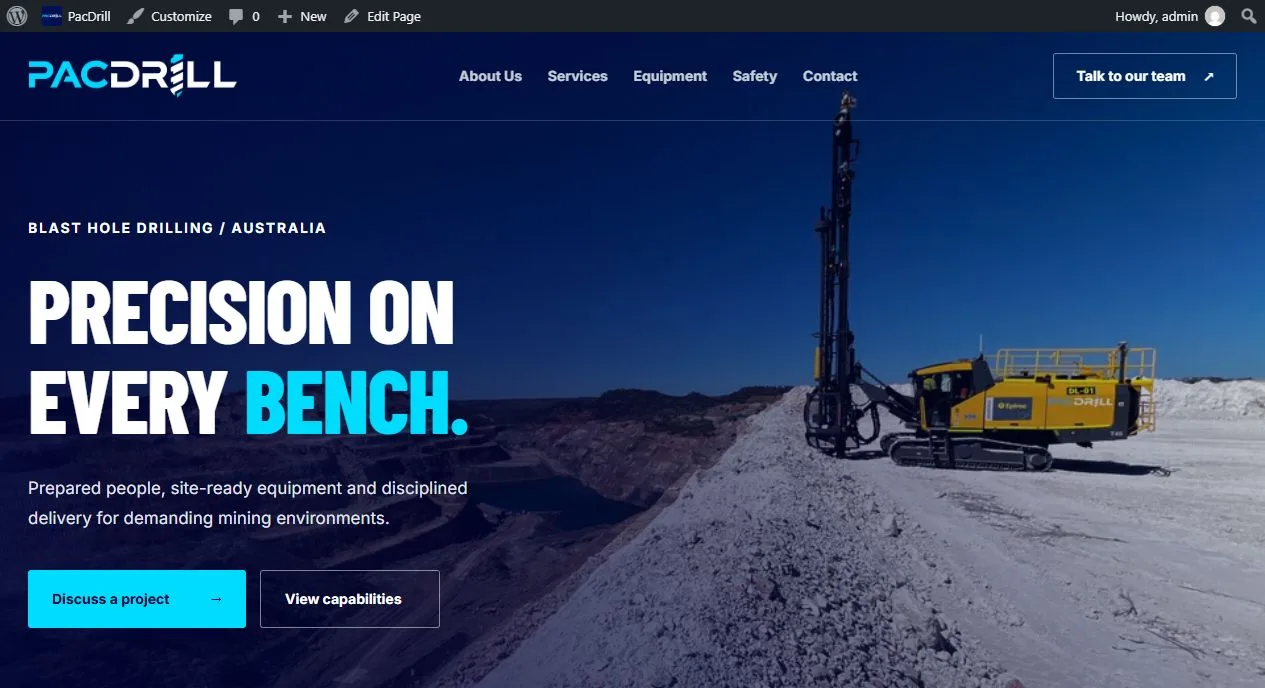
Mining and blast hole drilling · Australia · Website design and development
PacDrill
The brief
PacDrill needed a website that could explain its blast hole drilling capability to people assessing an operator for work on site. The intended position was safety-led, disciplined, and ready to mobilise: a practical operator able to compete for attention alongside larger drilling businesses without presenting itself as a generic corporate brand.
The site needed to make the essentials easy to find. A prospective client assessing a drilling contractor wants to understand the service, the equipment, the approach to safety, and the next step for discussing a project. The brief organized those questions into a capability architecture rather than relying on a broad introductory statement. The resulting pages are intended to support an informed enquiry, not to substitute for a formal assessment of a contractor’s suitability.
Constraints and approach
The design problem was to balance credibility with directness. Mining clients need clear information about site readiness and operating standards; a website that is overly abstract or promotional can make those details harder to locate. The brief therefore places practical capability ahead of corporate language. It uses a safety-as-standard narrative rather than treating safety as an isolated claim made only at the bottom of a page.
Another constraint was delivery weight. The project uses a custom WordPress theme and an asset pipeline under wp-content/themes/pacdrill/assets/. Hero imagery is prepared as purpose-built WebP assets instead of sending uploaded original files directly. The brief identifies this as a way to keep the payload lean; no measured load-time result is supplied, so none is claimed.
A capability page model
The information architecture is built around services, equipment, and safety. Each area answers a different question. A services page can explain what the operator does; equipment information can help a prospective client understand the machinery supporting that work; and safety content can show how site discipline fits into the operating approach.
Separating those subjects gives a reader a route to the detail most relevant to them while keeping the overall story connected. The goal is not to make a website perform the work of a tender, a site induction, or a technical assessment. It is to give a prospective client a clear starting point and enough context to decide what to discuss next.
The visual approach supports that purpose by presenting PacDrill as a working operator. The brief calls for a site-ready impression rather than a generic corporate presentation. Project imagery, service content, and direct language serve that direction. Any specific operational certification or compliance claim should be checked against the client’s current documentation before it is added.
Safety and mobilisation
Safety is presented as a standard part of how work is approached. In the page model it sits alongside the services and equipment, making it part of the capability story instead of a detached marketing statement. That distinction matters because the reader is evaluating how the operator works, not only what services appear in a menu.
The mobilisation workflow page extends the same practical sequence. It provides a place to explain the move from an initial project discussion toward readiness for site work. It can help a client understand the kinds of information that need to be discussed, while the actual mobilisation process remains subject to the project and site requirements. The website should not imply that a generic page replaces site-specific planning or induction.
Together, the safety and mobilisation content support a disciplined tone. They make operational context discoverable before a visitor reaches the enquiry, without asserting a safety record, accreditation, or performance result that has not been provided.
Theme, imagery, and conversion
The site uses a custom WordPress theme. Purpose-built WebP hero images are kept in the theme’s asset pipeline, so the design can use prepared visual assets rather than depending on full-size source uploads. This is a technical choice with a clear purpose: control the files used by the presentation and avoid sending unnecessarily heavy originals. The actual performance impact would require measurement on the deployed site.
The conversion path is deliberately simple: a visitor can review relevant capabilities and then use a clear “discuss a project” route. The site does not need multiple competing requests at every point to communicate the next step. A prospect can move from the information they need toward a conversation about their own requirements.
The documented outcome is the capability-led site and its prepared asset approach. No verified enquiry increase, contract value, speed score, or other business metric was supplied. Those results should be added only if the client confirms the figures and their measurement period.
Project image