Technology publishing · Web development and workflow automation
Technomalist
The brief
Technomalist is a technology newsroom designed to bring news, analysis, and practical guides together. The project connects an editorial website for readers with a workflow for discovering, reviewing, and publishing potential stories. My role covered the web experience and the automation described in the portfolio. The intended result was a publication where people could browse technology coverage while an editorial team retained a place in decisions about what should be published.
The publishing workflow matters because a newsroom has two different audiences. Readers need an understandable way to find and read stories; the people preparing those stories need a manageable process from the first candidate to a published article. Technomalist brings those concerns together in one project rather than treating the public website as the whole publishing operation.
Constraints and approach
The central constraint was preserving human editorial review while organizing repeatable steps around it. Automated discovery can produce a stream of candidates, but discovery alone does not establish which stories deserve publication. The workflow therefore includes classification and filtering before a person reviews the candidates. Approved articles can then be queued and published to the live site.
This is a description of the workflow documented in the portfolio, not a claim that all editorial work is automated. The precise division of responsibilities among contributors, the present implementation, and permission to describe every internal detail remain to be confirmed. The public-facing design also has to carry many stories at once without making a reader decipher the publishing process behind them.
What was built
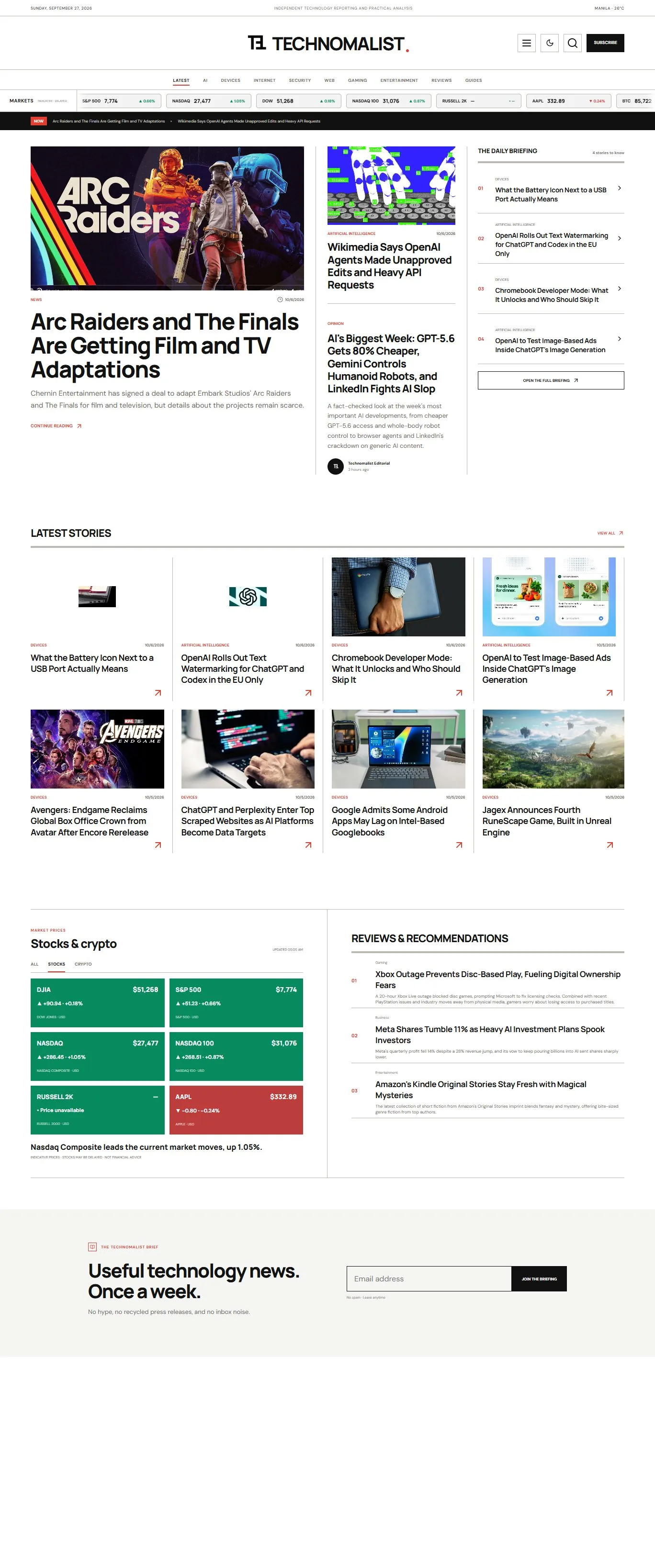
The website presents a technology newsroom with a lead story, supporting articles, a daily briefing, topic-based navigation, and a grid of recent coverage. These elements give readers more than one way into the publication: a prominent story for a quick starting point, topics for focused browsing, and a recent-stories grid for scanning the breadth of coverage.
The existing project draft also describes space for market information, recommendations, and a newsletter invitation. Together, these sections make the homepage a useful overview rather than a single list of headlines. The responsive website is paired with the editorial workflow described below. The screenshot shown on this page is an existing portfolio asset; permission to reuse the image and any third-party imagery visible within it should be confirmed before publication.
Technical decisions
The documented pipeline begins by collecting potential stories from RSS feeds. It classifies and filters the incoming items, routes candidates through human editorial review, and queues approved articles for publication. This sequence separates candidate gathering from the editorial decision. The reader-facing site then presents the resulting coverage through its article and topic structure.
The portfolio associates the project with Next.js, Node.js, Supabase, Cloudflare Workers, and Discord.js. Those names describe the technologies recorded for the project; their current use and precise responsibilities in the pipeline need confirmation. The important design principle supported by the record is the combination of automated repeatable steps with a human review point. It would be misleading to infer an unrecorded service architecture or claim a specific performance benefit from the technology list alone.
The editorial journey
The public homepage and the internal workflow solve different parts of the same publishing problem. The homepage gives a reader a quick view of the publication through a lead story, supporting coverage, recent articles, and topic navigation. The project draft describes a daily briefing as well. These elements provide several routes into the content without requiring the reader to know how an article was discovered or reviewed.
Behind the public view, the documented workflow begins with RSS feeds. Classification and filtering organize potential stories before a human review step. An approved item then enters a queue for publication. Describing the stages in this order makes the review boundary clear: an item collected from a feed is a candidate, not automatically an approved article.
The distinction also explains why automation and editorial judgment coexist in the project description. Repeated collection and routing steps can be organized as a workflow while a person remains responsible for review. The source notes do not say that the process eliminates manual work, guarantees accuracy, or publishes every candidate. Those would be additional claims requiring evidence.
The draft lists Next.js, Node.js, Supabase, Cloudflare Workers, and Discord.js among the project technologies. The current implementation should be checked before presenting the list as a definitive architecture. A future revision could document each component’s precise role once that information and the contributions of collaborators are confirmed.
Result and reflection
The documented result is a reader-facing technology publication connected to a structured path from story discovery to review and publication. The project demonstrates how an editorial website and its operational workflow can be considered together. The homepage gives readers a way to navigate coverage, while the workflow gives the editorial process a sequence of identifiable stages.
No verified measurement of time saved, publishing frequency, traffic, or number of sources is available in the project notes. Those measures should be added only after they have been confirmed with a measurement period. Likewise, the detailed contributions of collaborators and the current production configuration require review. The case study therefore focuses on the features and process already documented rather than presenting estimated business results as fact.
Project image