Executive media training · New York and beyond · Website design and development
Success in Media
The brief
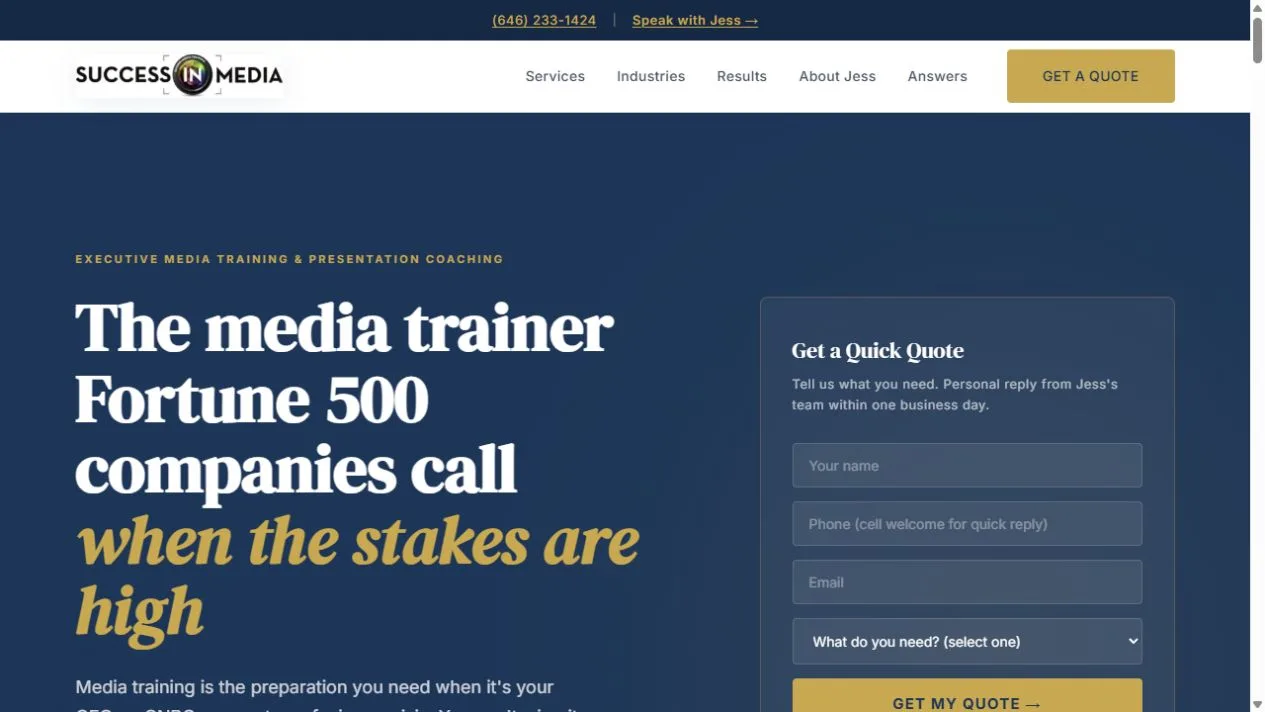
Success in Media provides executive media training and presentation coaching to clients in New York, across the United States, and internationally. The site is a personal-brand authority experience for Jess Todtfeld, a former ABC, NBC, and FOX producer. The design needed to communicate credibility to senior buyers, including organizations evaluating training for high-stakes interviews and presentations.
The project uses a long-form page to explain the offer and help a visitor move toward an enquiry. Its challenge was to make that journey useful to people with different amounts of time: a reader might want a quick answer, a detailed explanation of the training, a practical demonstration, or a direct route to ask about a program. The brief therefore combines credibility, education, answers, and conversion within the same experience.
Constraints and approach
A personal-brand website must make the person’s experience clear without requiring a visitor to search through the whole page before understanding the service. At the same time, a considered purchase such as executive training can involve questions about the format, audience, and fit. A single short pitch would not serve every stage of that evaluation.
The site uses a custom front-end build with a versioned asset directory and no page builder, according to the project brief. The visual layer is supported by a crawlable-text-first structure: important service information is available as page text rather than existing only inside graphics or video. The design also includes lazy video embeds so that video does not have to be treated as an immediate prerequisite for reading the page. No measured improvement in loading speed or enquiries was supplied.
Conversion sequencing on a long page
The opening gives visitors a direct route to request a quote. A form above the fold makes the next action available to someone who already knows what they need. The live page also presents a quick-answer block near the top, giving skimmers a concise explanation of the service before they continue through the longer narrative.
Further down the page, service information, proof, and answers provide context for visitors who need more detail. The brief describes a testimonial switcher and an industry matrix as part of this sequence. Those components address different questions: testimonials present experiences attributed to others, while an industry matrix helps readers locate their own context in the service offer. This case study does not invent or reproduce endorsements or claim their effect on conversion.
The resulting architecture does not force every visitor to take the same path. A buyer can move directly toward a quote or spend time understanding the offer first. The important design decision is the ordering of information and actions, not a claim that the page produced a specific number of leads.
An interactive teaching component
The brief identifies an interactive sound-bite demonstration that teaches part of the method before the call to action. That component gives visitors an opportunity to experience an idea rather than only read a description of training. It turns a concept central to media preparation into an interaction that can support the broader explanation on the page.
For a service based on expertise, a demonstration can help a prospective client understand the type of work being offered. It should be read here as a documented design feature, not as proof that visitors learned a measured skill or that the interaction increased sales. The available project materials do not include a controlled test or engagement data.
The component sits within a larger content structure. It is one way to introduce the method, while the surrounding text, service descriptions, and enquiry route let visitors continue according to their needs. The public site may change over time, so the current behavior should be reviewed before updating this account with further technical details.
FAQ, video, and result
A full FAQ provides a place for the questions a buyer may have after reading the main offer. Grouping answers in the page architecture can reduce the need for a visitor to search elsewhere for basic information about the service. The brief identifies this FAQ as part of the long-form conversion sequence; it does not establish which questions most influenced a purchase.
Video embeds are lazy, allowing the page to avoid immediately loading every video as part of the first reading experience. The crawlable-text-first approach gives the visual layer a textual foundation, so important information is not dependent on a video playing. Both choices address how the page is delivered and understood, but their performance and search effects require measurement rather than assumption.
The documented result is a custom front-end authority site combining early quote access, a quick answer, interactive teaching, testimonials, industry information, and a full FAQ. No verified conversion rate, revenue figure, performance score, or increase in enquiries is included. The live site is the source for the public service context; project implementation details come from the supplied brief.
Project image